Manual Processes Slowing FinTech Operations? How AI Automation Accelerates Compliance and Workflows
Calibraint
Author
March 6, 2026
Financial technology built its reputation on speed. Platforms like Stripe and PayPal process millions of transactions every day, while digital banks such as Revolut onboard new customers within minutes.
Yet behind these seamless experiences, many fintech operations still rely on manual compliance work. Teams spend hours reviewing identity documents, investigating transaction alerts, and compiling regulatory reports. As volumes grow, these human-dependent workflows create bottlenecks that can slow critical decision-making.
With AI development, fintech platforms are integrating AI automation to enhance compliance and streamline transaction processing, workflow management, and risk detection. By automating routine compliance tasks, organizations can focus their human expertise on cases that truly require judgment, improving both speed and accuracy.
Examining how AI automation for fintech compliance streamlines these operations reveals the practical ways automation strengthens financial performance while maintaining regulatory integrity.
The Operational Bottleneck Inside FinTech
Fintech products often appear highly automated from the outside. A customer opens an account in minutes or completes a payment within seconds. Inside the organization, however, operational processes frequently remain fragmented.
Compliance teams still review identity documents manually. Risk analysts review transaction alerts generated by rigid rules. Regulatory reporting often requires several departments to collect information across different systems.
These tasks create a significant operational burden.
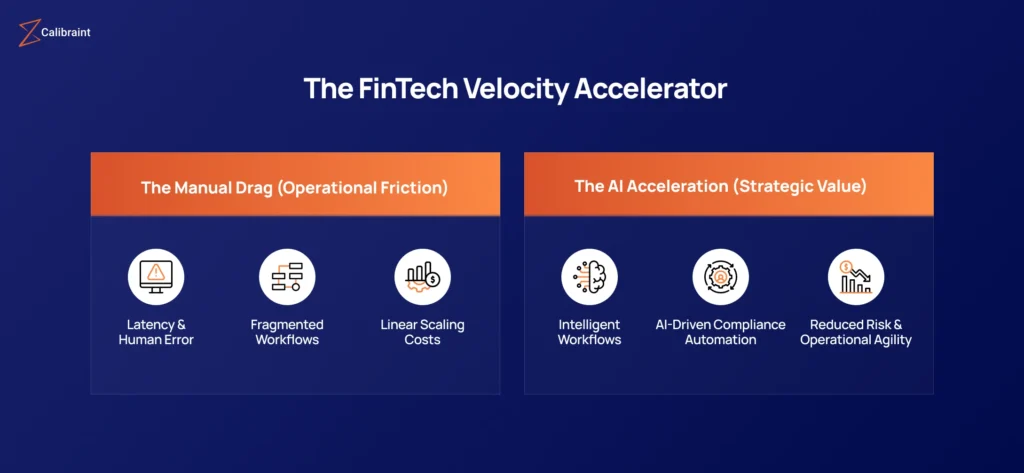
Manual work introduces delays in decision-making. Analysts spend hours reviewing routine alerts that contain no real risk signals. Compliance officers reconcile reports across disconnected systems. Operations teams manage approvals through email threads and spreadsheets.
The result is operational friction that grows as transaction volumes expand.
This is why many financial platforms have started adopting AI automation for fintech compliance as part of broader AI driven financial operations automation strategies. By introducing structured automation into compliance workflows, fintech companies reduce manual intervention while maintaining regulatory oversight.
Automation does not eliminate human judgment. Instead, it supports operational teams by filtering routine work, organizing information, and prioritizing cases that require deeper investigation.
Over time, this approach helps reduce fintech manual tasks that previously consumed operational resources.
The value of AI automation for fintech compliance lies in its ability to coordinate multiple operational functions simultaneously. Rather than addressing one task in isolation, intelligent automation connects data, analysis, and workflow management across the compliance environment.
Intelligent Data Processing
Financial operations generate large volumes of unstructured data. Documents, transaction records, and regulatory filings often exist in different formats.
AI automation systems process these datasets and extract relevant information automatically. Compliance teams receive structured information without manually reviewing each document.
This capability supports compliance automation by organizing regulatory documentation efficiently.
Continuous Compliance Monitoring
Traditional monitoring systems evaluate transactions through fixed rules. AI models instead analyze patterns across historical activity.
This allows AI automation for fintech compliance to detect irregular behavior that rule-based systems may overlook. Analysts receive prioritized alerts that require investigation rather than reviewing thousands of routine notifications.
Coordinated Workflow Automation
Compliance work rarely happens in isolation. A flagged transaction might require approval from risk teams, documentation from compliance officers, and reporting to regulators.
Workflow automation coordinates these actions through structured approval processes. Tasks move between departments automatically while maintaining clear audit trails.
Real Time Operational Visibility
Operations leaders often struggle to obtain a complete view of compliance activity across multiple systems.
AI driven financial operations automation consolidates operational data and provides continuous monitoring dashboards. Compliance teams gain visibility into risk indicators, review activity, and reporting status.
This visibility improves response times and strengthens operational oversight.
A Practical Framework for Implementing AI Automation
Adopting AI automation for fintech compliance requires structured planning. Financial operations contain interconnected processes, and automation must integrate carefully with regulatory controls.
A practical implementation approach typically includes five stages.
Operational Process Mapping
Organizations begin by identifying manual processes that create operational delays. Document reviews, transaction monitoring, and reporting workflows often reveal immediate automation opportunities.
Compliance Risk Assessment
Risk teams evaluate which processes require stricter oversight. Automation must support compliance rather than weaken regulatory controls.
AI Model Integration
Machine learning systems analyze operational data and detect patterns relevant to compliance monitoring. This stage forms the technical foundation of AI automation for fintech compliance.
Workflow Automation Layer
Once data analysis capabilities exist, workflow automation coordinates approvals, investigations, and documentation processes.
Continuous Monitoring
Operational dashboards monitor system performance and compliance outcomes. Teams refine automation rules based on evolving regulatory expectations.
This framework ensures that automation strengthens compliance processes rather than simply accelerating them.
Business Impact of AI Automation
Organizations that implement AI automation for fintech compliance often observe measurable operational improvements.
First, compliance accuracy improves. Automated monitoring systems review larger volumes of transactions without fatigue, reducing the likelihood of overlooked alerts.
Second, operational speed increases. Identity verification, risk detection, and reporting processes move faster when automation handles routine tasks.
Third, operational costs stabilize. Compliance teams focus on high-value investigations instead of repetitive administrative work.
Collectively, these improvements demonstrate how AI accelerates fintech operations while maintaining compliance standards.
More importantly, automation enables operational teams to focus on strategic priorities rather than routine administrative work.
The Strategic Direction of FinTech Operations
Financial services infrastructure continues to evolve as transaction volumes increase and regulatory oversight intensifies.
Many fintech organizations now recognize that internal operations must evolve alongside customer-facing products. Efficient payments or lending platforms still depend on reliable compliance systems.
This realization has accelerated the adoption of AI automation for fintech compliance across digital financial services.
Future operational models will likely integrate:
intelligent compliance monitoring systems
automated regulatory reporting pipelines
connected operational dashboards
predictive risk analysis tools
These capabilities collectively improve operational resilience and financial oversight.
Organizations that integrate AI-driven financial operations automation today establish a foundation for scalable growth.
Real World Adoption Across Financial Platforms
Several digital financial platforms have already integrated automation into compliance operations.
Companies such as Stripe and Revolut rely on technology-driven compliance systems to support large volumes of digital transactions. Automated monitoring systems review payments and identify unusual patterns while operational teams focus on higher-risk cases.
Similarly, payment platforms built by Block, Inc. integrate machine learning tools to monitor transaction behavior across merchant ecosystems.
The common objective across these platforms is operational efficiency. Automation processes routine compliance activity while human analysts review complex cases.
These implementations demonstrate how AI automation for fintech compliance improves operational reliability without removing human oversight.
Fintech innovation often focuses on customer experiences, such as faster payments or digital lending platforms. Yet the reliability of these services ultimately depends on the efficiency of internal operations. Manual compliance processes can slow decision-making and create friction, and as transaction volumes grow, these operational inefficiencies become more visible.
Implementing AI automation for fintech compliance provides a clear solution. By integrating intelligent monitoring, workflow automation, and real-time compliance analysis, financial platforms streamline operations, reduce routine manual work, and allow teams to focus on decisions that require judgment. This structured approach strengthens regulatory accountability while improving operational speed and precision.
For organizations ready to convert compliance from a cost center into a competitive advantage, Calibraint engineers the architecture necessary to scale without compromise. We provide the technical depth and strategic framework to automate complex workflows reliably, ensuring your firm maintains regulatory dominance while accelerating market growth.
FAQs
1. How does AI automation improve compliance in FinTech?
AI automation improves compliance by analyzing large volumes of financial data and identifying unusual patterns in real time. Systems built for AI automation for fintech compliance help monitor transactions, verify identities, and organize regulatory reporting while maintaining consistent audit trails.
2. Can AI reduce manual processes in financial operations?
Yes. AI systems automate repetitive tasks such as document verification, transaction monitoring, and compliance reporting. This reduces manual review workloads and allows operational teams to focus on complex investigations and decision-making.
3. Why are FinTech companies adopting AI workflow automation?
FinTech companies adopt workflow automation to manage growing transaction volumes and regulatory requirements more efficiently. Automated workflows coordinate compliance reviews, approvals, and reporting processes across teams while maintaining clear operational oversight.
Calibraint
Author
March 6, 2026
Let's Start A Conversation
Manage Consent
To provide the best experiences, we use technologies like cookies to store and/or access device information. Consenting to these technologies will allow us to process data such as browsing behavior or unique IDs on this site. Not consenting or withdrawing consent, may adversely affect certain features and functions.
Functional
Always active
The technical storage or access is strictly necessary for the legitimate purpose of enabling the use of a specific service explicitly requested by the subscriber or user, or for the sole purpose of carrying out the transmission of a communication over an electronic communications network.
Preferences
The technical storage or access is necessary for the legitimate purpose of storing preferences that are not requested by the subscriber or user.
Statistics
The technical storage or access that is used exclusively for statistical purposes.The technical storage or access that is used exclusively for anonymous statistical purposes. Without a subpoena, voluntary compliance on the part of your Internet Service Provider, or additional records from a third party, information stored or retrieved for this purpose alone cannot usually be used to identify you.
Marketing
The technical storage or access is required to create user profiles to send advertising, or to track the user on a website or across several websites for similar marketing purposes.