A Complete Playbook for Companies to Tokenize Patent Data and Internal Expertise Using Blockchain Solutions
Calibraint
Author
April 10, 2026
Introduction
Most enterprises are sitting on billions of dollars in dormant intellectual property. Patents that never get licensed, internal expertise that walks out the door, and knowledge assets that generate zero return. The problem is not a lack of IP. It is a lack of infrastructure to manage, monetize, and protect it at scale. That is exactly where enterprise blockchain solutions are rewriting the rules.
As a Blockchain Development Company with deep roots in enterprise transformation, Calibraint has seen how organizations that fail to modernize their IP infrastructure bleed revenue, face costly disputes, and lose competitive ground. If your patent portfolio is still running on spreadsheets and siloed databases, this is not a technology gap. It is a strategic liability that compounds every quarter.
The Hidden Problem in Patent and Knowledge Management
Most large organizations manage patents across multiple legal teams, business systems, and licensing agreements that were never designed to work together. The result is fragmentation. Patent data lives in one system, licensing contracts in another, and royalty tracking in a file that multiple people partially maintain. Internal expertise, meanwhile, is almost entirely unstructured and buried in email threads or outdated internal documents.
The downstream effects are serious. Licensing inefficiencies mean deals take months to negotiate when they should take days. Lack of transparency creates disputes over ownership, revenue splits, and who authorized what. Revenue leakage is widespread because a significant portion of patent portfolios are never monetized, not because the IP lacks value, but because organizations lack the operational infrastructure to activate it.
According to WIPO’s Global Innovation Index, IP-intensive industries account for over 45% of GDP in high-income economies, yet a large share of enterprise patents remain unlicensed and inactive. The core challenge is that IP management depends on trustworthy records and traditional registries are often fragmented, slow to update, and difficult to reconcile across borders and intermediaries. That is not a process problem. It is an architecture problem.
What Does It Mean to Tokenize Intellectual Property?
Tokenizing intellectual property on blockchain means representing a real-world asset such as a patent, a license right, or a body of internal expertise as a digital token on a blockchain network. Each token carries embedded information including ownership records, rights terms, transaction history, and usage permissions. The token does not replace the legal asset. It creates a verifiable, programmable digital record of it.
When you tokenize intellectual property on blockchain, ownership becomes provable and portable. Any authorized party can verify the chain of title without a legal team intermediary. Rights become programmable, meaning licensing terms can be encoded directly into the token so that royalty payments trigger automatically when conditions are met. Fractional ownership also becomes viable, allowing multiple parties to co-own a patent’s licensing revenue stream without complex legal scaffolding.
This applies beyond patents. Companies are also beginning to tokenize intellectual property on blockchain in the form of internal expertise including proprietary methodologies, research findings, process documentation, and institutional knowledge that carries real competitive value but currently lives nowhere structured enough to be monetized or protected.
How Enterprise Blockchain Solutions Enable This Transformation
Enterprise blockchain solutions provide the foundational infrastructure that makes IP tokenization scalable and audit-ready.
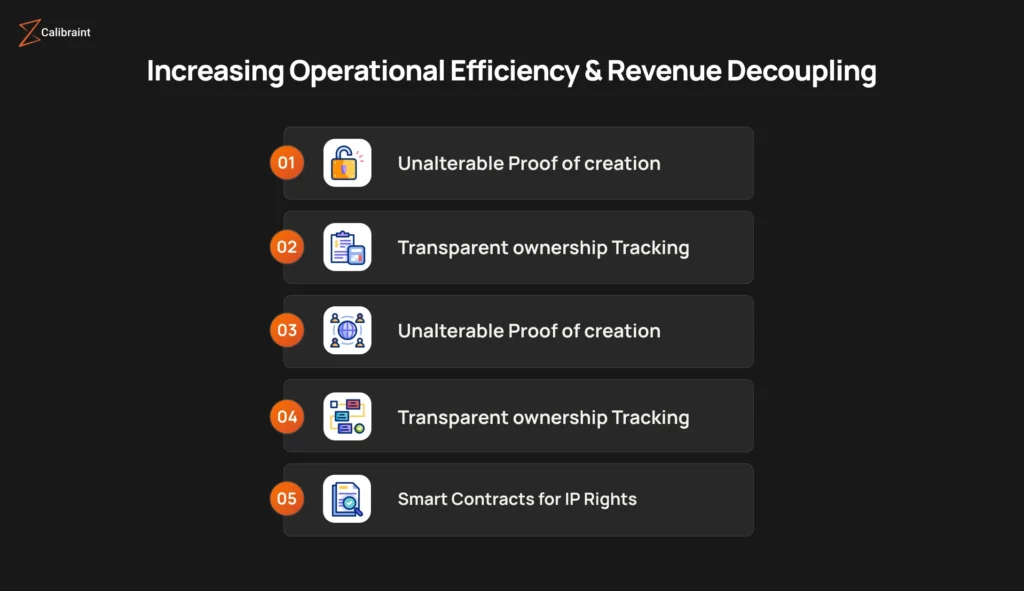
Smart contracts are at the core. When licensing terms are encoded on-chain, execution becomes automatic. A licensee triggers usage, the smart contract verifies the terms are met, and royalties are distributed to rights holders without manual intervention. This removes the single largest source of licensing friction, which is the lag between usage and payment.
Ownership tracking becomes permanent and verifiable. Once a rights event is recorded on-chain, altering it without detection becomes extremely difficult, which supports clean audit trails for disputes and compliance reviews. For enterprises managing large patent portfolios across multiple geographies, this is a meaningful operational upgrade.
Patent data management blockchain solutions enable organizations to maintain a single, synchronized source of truth for every patent’s status, ownership, and licensing history. Every transaction and every royalty payment is recorded with a timestamp and cannot be retroactively altered. This matters significantly in regulated industries and in any IP dispute scenario.
For enterprises looking to implement this at scale, investing inenterprise blockchain development services ensures the right architecture, security frameworks, and integration capabilities are in place from day one.
As highlighted by the World Economic Forum’s research on digital assets, blockchain-based ownership infrastructure reduces reconciliation costs and accelerates the legal enforceability of rights transfers across jurisdictions.
Step-by-Step Playbook for Enterprises
Step 1: IP Asset Assessment
Before any technology is deployed, map your IP landscape completely. Catalog all patents, pending applications, trade secrets, proprietary methodologies, and internal knowledge assets. Identify current ownership structures, existing licensing agreements, and jurisdictional considerations. This audit forms the data foundation that everything else is built on.
Step 2: Data Structuring for On-Chain Readiness
Raw patent data needs to be structured, classified, and prepared appropriately. Sensitive information such as unpublished inventions and confidential terms stays off-chain. What goes on-chain are identifiers, ownership records, rights events, and licensing triggers. Patent data management blockchain solutions help standardize this structuring layer to ensure the system works cleanly across departments and legal boundaries.
Step 3: Tokenization Model Design
Decide how each IP category will be tokenized. Patents might be represented as unique tokens with embedded licensing terms. Revenue rights might be divided among co-owners. Internal expertise assets might be structured as access-controlled credential tokens. The model must align with your business goals, whether monetization, protection, or both.
Step 4: Platform Development
This is where a qualified Blockchain Development Company becomes essential. Building an enterprise-grade tokenization platform requires expertise in smart contract design, permissioned ledger architecture, integration with existing business systems, and compliance engineering. Most enterprises benefit from a hybrid setup where sensitive IP data sits on a permissioned chain while timestamping and provenance verification are anchored publicly.
Step 5: Governance Framework
Define clearly who can write records, who can initiate licensing transactions, how disputes are escalated, and how the system is audited. Enterprise blockchain solutions are only as reliable as the governance structures that support them.
Key Business Benefits
Monetization at scale:Patent portfolio management software built on blockchain enables organizations to identify and activate dormant patents through automated licensing pipelines, converting static assets into recurring revenue without expanding headcount.
Transparency and trust: Multi-party IP agreements such as joint ventures, consortium research, and cross-licensing deals become easier to manage when all parties share a permanent record of rights and transactions.
Faster licensing cycles: Automated smart contract execution can compress licensing timelines from months to days, which matters greatly in fast-moving industries.
Risk reduction: Permanent provenance records and automated compliance checks reduce exposure to IP disputes, unauthorized sublicensing, and cross-border enforcement failures.
Auditability for regulators: Enterprise blockchain solutions create a clear, timestamped record of every IP event, which simplifies regulatory reporting and supports compliance in industries with strict oversight requirements.
Real-World Use Cases Across Industries
Pharmaceuticals: Drug discovery organizations managing large patent portfolios across research partnerships can use enterprise blockchain solutions to automate royalty distribution, track co-ownership across research consortia, and create clean records for regulatory submissions.
Technology companies: Businesses with large software patent portfolios can tokenize intellectual property on blockchain to manage cross-licensing agreements with partners, automating terms that would otherwise require constant legal review.
Manufacturing and industrial R&D: Manufacturers with proprietary process innovations can use blockchain to grant granular access rights to specific partners without exposing the full IP architecture. Patent data management blockchain solutions adapted for process IP are increasingly common in this sector.
Knowledge-based enterprises: Consulting firms, research institutions, and professional services organizations are exploring how to tokenize internal methodologies and expertise, creating digital assets from institutional knowledge that can be licensed, monetized, or protected. According to McKinsey’s research on knowledge-intensive industries, organizations that systematically manage and activate internal knowledge assets outperform peers on innovation metrics consistently.
Why Enterprises Need a Consulting and Development Partner
This is where many enterprise blockchain projects stall. The technical complexity of building a production-grade tokenization platform is significant, but it is not the hardest part. The hardest part is aligning legal, technical, compliance, and business requirements into a coherent system that actually gets adopted across the organization.
That is why blockchain consulting services for business are not optional. They are the difference between a pilot that dies and a platform that scales. A qualified consulting partner brings pattern recognition across enterprise deployments, established architecture frameworks that accelerate delivery, and the cross-functional expertise to bridge legal, IT, and finance stakeholders.
Blockchain consulting services for business should cover not just development, but strategy definition, tokenization model design, regulatory assessment, and post-launch governance. The enterprises that get the most value from IP tokenization are those that treat it as a business transformation program rather than a technology project.
The right partner also understands that patent portfolio management software and tokenization infrastructure must integrate with existing systems including IP management platforms, ERP systems, legal repositories, and enterprise identity frameworks. Building in isolation creates silos. Building with an integration-first approach creates leverage.
Blockchain consulting services for business delivered by Calibraint follow a proven methodology that starts with business outcomes and works backward to technology decisions, ensuring the platform serves real enterprise needs rather than theoretical ones.
Conclusion: Build the Infrastructure Your IP Deserves
Your patents, your proprietary processes, your institutional expertise. These are not just legal assets. They are strategic capital. And right now, most enterprises are managing that capital with tools built for a different era.
Enterprise blockchain solutions offer a fundamentally better architecture where IP ownership is provable, licensing is automated, revenue is traceable, and disputes are preventable. The question is not whether this infrastructure will become standard. It will. The question is whether your organization is building it now or playing catch-up later.
Calibraint is an enterprise-grade Blockchain Development Company with end-to-end expertise across tokenization platform development, smart contract engineering, IP system integration, and blockchain consulting services for business. We do not deliver proofs of concept. We deliver production systems that enterprise decision-makers can rely on.
If you are ready to transform your patent portfolio and internal expertise into a managed, monetizable, blockchain-native asset layer, let’s build it together.
How do you tokenize intellectual property using blockchain technology?
Tokenizing intellectual property using blockchain technology involves converting IP assets such as patents, trade secrets, or proprietary methods into digital tokens on a blockchain network. Each token holds ownership data, licensing terms, and usage rights that can be executed automatically through smart contracts. The process starts with an IP audit, followed by data structuring, token model design, and platform development. Working with a qualified Blockchain Development Company ensures the system is built to enterprise compliance and integration standards from the ground up.
What are the benefits of blockchain for patent management in enterprises?
Blockchain brings several concrete benefits to enterprise patent management. It creates permanent, tamper-evident ownership records that support dispute resolution. It automates licensing execution and royalty distribution through smart contracts. Patent data management blockchain solutions eliminate fragmentation by creating a single source of truth across jurisdictions and business units. The measurable outcomes include lower legal overhead, faster licensing cycles, improved monetization rates on dormant patents, and reduced exposure to IP disputes.
How does asset tokenization platform development work for businesses?
Asset tokenization platform development begins with a strategy phase that identifies which IP assets will be tokenized and what business outcomes the platform needs to support. A Blockchain Development Company then designs the token architecture, builds the smart contract logic, integrates the platform with existing business systems, and deploys it on an appropriate blockchain network. Enterprise blockchain solutions of this kind typically follow a phased delivery model covering assessment, architecture, initial deployment, and enterprise rollout.
Can companies tokenize internal knowledge and expertise using blockchain?
Yes, and this is one of the most underused opportunities in enterprise blockchain adoption today. Proprietary methodologies, process innovations, research findings, and institutional knowledge can all be structured and tokenized. Blockchain consulting services for business now increasingly cover knowledge asset tokenization, helping organizations create governed digital representations of internal expertise that can be licensed to partners, protected from unauthorized use, or used to demonstrate innovation provenance in regulatory contexts.
What is the cost of developing a tokenization platform for intellectual property?
The cost depends on the scope of IP assets being tokenized, the complexity of licensing structures, integration requirements, and the blockchain infrastructure selected. A foundational patent portfolio management software layer built on enterprise blockchain solutions can range from a focused deployment covering a single IP category to a comprehensive enterprise platform spanning multiple asset classes and jurisdictions. The right starting point is a structured scoping engagement with an experienced blockchain consulting services for business provider, which is exactly how Calibraint approaches every enterprise engagement before a single line of code is written.
Calibraint
Author
April 10, 2026
Let's Start A Conversation
Manage Consent
To provide the best experiences, we use technologies like cookies to store and/or access device information. Consenting to these technologies will allow us to process data such as browsing behavior or unique IDs on this site. Not consenting or withdrawing consent, may adversely affect certain features and functions.
Functional
Always active
The technical storage or access is strictly necessary for the legitimate purpose of enabling the use of a specific service explicitly requested by the subscriber or user, or for the sole purpose of carrying out the transmission of a communication over an electronic communications network.
Preferences
The technical storage or access is necessary for the legitimate purpose of storing preferences that are not requested by the subscriber or user.
Statistics
The technical storage or access that is used exclusively for statistical purposes.The technical storage or access that is used exclusively for anonymous statistical purposes. Without a subpoena, voluntary compliance on the part of your Internet Service Provider, or additional records from a third party, information stored or retrieved for this purpose alone cannot usually be used to identify you.
Marketing
The technical storage or access is required to create user profiles to send advertising, or to track the user on a website or across several websites for similar marketing purposes.