Enterprise Blockchains That Deliver Real Business Value: Lessons from Live Deployments
Calibraint
Author
April 7, 2026
There is a specific kind of frustration that builds when a technology keeps promising transformation but keeps delivering pilots.
Blockchain has lived in that space for most of its enterprise life. The whitepapers were compelling. The architecture made sense. The use cases looked real on the slides. And then, somewhere between the proof of concept and the production environment, momentum quietly stalled.
That frustration is worth taking seriously because the organizations working past it right now are not doing anything radically different from what was tried before. They are doing the same things with sharper focus, cleaner governance, and a far more specific definition of the problem they are actually solving.
This is what enterprise blockchain development services look like when they work. Not as a technology experiment, but as a structural answer to a structural problem.
Start Here: The Problem Nobody Talks About Honestly
Before getting into what works, it is worth naming what went wrong in the first wave.
Most early enterprise blockchain projects were built around the technology rather than around the pain. Teams identified that blockchain was theoretically suited to multi-party coordination. Then they went looking for a use case. That sequence, technology first and problem second, is the reason so many pilots produced impressive demonstrations and zero production deployments.
The organizations now generating real business value from enterprise blockchain reversed that order. They started with a coordination problem so expensive, so persistent, and so resistant to conventional solutions that it had survived multiple software generations untouched. Then they asked whether blockchain was the right architecture for it.
In almost every successful deployment, the answer shared a common shape: multiple parties, none of whom trusted a single counterparty to own the data, all needing to act on the same information in real time.
That is the precise condition where blockchain development stops being a pitch and starts being an engineering decision.
The Scale of What Is Actually Being Left on the Table
To understand why certain industries moved decisively, it helps to understand the cost of inaction.
Trade finance is the clearest example. A single letter of credit transaction can involve seventeen or more parties, five days of processing, and paper documents traveling across three continents. The World Economic Forum estimates that trade finance inefficiency costs the global economy over one trillion dollars annually in missed trade opportunities alone.
Pharmaceutical supply chains carry a different kind of cost. Counterfeit drugs cause roughly one million deaths per year, according to World Health Organization data. The traceability infrastructure that would prevent this exists in fragments, owned by competing parties, and not interoperable by design.
Insurance claims average twelve to fifteen manual touchpoints per settlement. Cross-border payments through correspondent banking can take four business days while institutions independently verify records that are, in many cases, describing the same transaction.
Enterprise blockchain implementation does not solve software problems. They solve coordination and trust problems, and that distinction makes enterprise blockchain implementation worth the architectural investment.
The Framework That Actually Produces Results
Before looking at individual deployments, it is worth understanding the methodology that separates the ones that reached production from the ones that are still in the pilot queue.
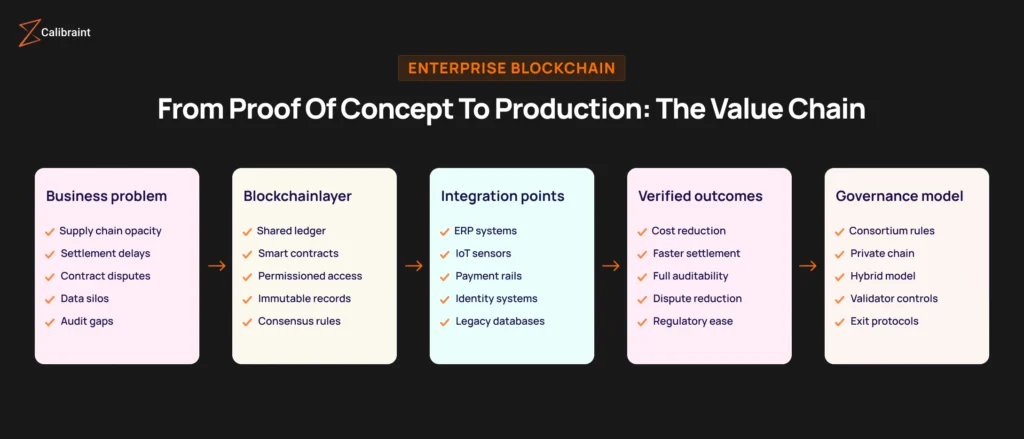
Four components appear consistently across every deployment that delivered measurable enterprise blockchain benefits.
Problem specificity. Blockchain does not improve processes broadly. It solves a narrow category of problem: multi-party coordination where no single organization can or should control the data. Deployments that began without this clarity spent months building infrastructure for a problem that was never precisely defined.
Consortium architecture designed before the code. The network is only as strong as its weakest participant’s integration. Technical standards, onboarding requirements, and governance rules need to exist before the first node goes live. Negotiating them after deployment is the reason most consortium projects dissolve.
Integration fidelity. The full business value of enterprise blockchain materializes only when the chain connects to existing ERP, IoT, and identity systems without asking operational teams to change how they work. The blockchain should be essentially invisible to end users. Its value shows up in the data, not in a new interface they have to learn.
Regulatory alignment from the start. GDPR’s right to erasure sits in direct tension with blockchain immutability. An enterprise blockchain implementation that ignores this ends up rebuilding architecture after deployment. The organizations that map regulatory requirements to the architecture in the design phase do not face this problem.
Organizations that follow this sequence consistently move from pilot to production within twelve to eighteen months. Those that skip the governance and consortium design tend to remain in pilot indefinitely.
A 2023 Coinbase survey found that 83% of Fortune 500 executives familiar with blockchain said their companies have active initiatives or are planning them, with the average project budget approaching $5.8 million. This signals a clear shift. Blockchain is no longer treated as an experimental concept. It is being funded as an operational priority.
That shift becomes more meaningful when viewed through actual deployment outcomes. IBM’s Food Trust platform, implemented with Walmart, reduced the time required to trace a food product back to its source from 6 days and 18 hours to 2.2 seconds. The improvement is not incremental. It changes how organizations respond to risk, compliance, and product recalls in real time.
However, technical success alone does not guarantee long-term viability. The TradeLens experience, the joint platform developed by Maersk and IBM, makes this clear. The architecture functioned as intended, yet adoption stalled. Participants recognized the value, but there was no structural requirement to join the network. Without aligned incentives, the ecosystem did not sustain itself.
This distinction matters. The difference between a working system and a successful one often lies outside the technology itself. Participation models, governance structures, and commercial alignment determine whether a network scales or stalls.
The platforms that are gaining traction today reflect this learning. They are designed with participation incentives, governance clarity, and integration pathways defined from the outset. This is the level of structural discipline expected from enterprise blockchain development services that deliver measurable outcomes.
Why the Technical Architecture Decision Is Non-Negotiable
One decision determines more of the outcome than any other: permissioned versus public network architecture.
For enterprise contexts, permissioned networks such as Hyperledger Fabric, R3 Corda, and Quorum are the standard. They allow organizations to control who reads data, who writes transactions, and who validates blocks. Public chains cannot make those guarantees at the base layer.
Smart contracts extend this precision into operations. A pharmaceutical company shipping temperature-sensitive goods can connect IoT sensors to the chain so that temperature data is written automatically. A smart contract then monitors that data and, if a threshold is breached, triggers a quality hold, notifies the carrier, and initiates an insurance claim, all without a single human touchpoint from detection to action.
This is what blockchain problems and solutions look like in production. The problem is coordination latency and manual intervention. The solution is automated, auditable rule execution that runs without asking anyone for permission.
The organizations seeing the strongest enterprise blockchain benefits designed this governance architecture before they wrote a line of code. The question of who can join the network, who administers the smart contracts, and what happens when a participant exits was resolved in legal and technical frameworks before the build phase began.
Choosing the right enterprise blockchain development services partner means selecting a team that treats these governance questions with the same rigor as the code itself.
The Competitive Window Is Narrowing
The deployments described here did not begin with certainty. They began with a rigorous question and a team capable of building the answer.
If this is the exact stage your organization is at, where high-friction workflows are clear but the architecture to resolve them is not, this is where a focused evaluation matters more than another round of tools or prototypes. A structured workflow audit and consortium feasibility assessment can help translate uncertainty into a buildable enterprise blockchain roadmap.
At Calibraint, our strategy with blockchain is refreshingly straightforward: we never lead with the technology itself. Instead, our first step is always to deeply understand a client’s workflow and determine if blockchain truly offers the right mechanism to improve it
After all, the real advantage isn’t found in simply adopting blockchain; it comes from solving long-standing, complex problems with newfound clarity and confidence.
FAQs
1. How does enterprise blockchain differ from public blockchain?
Enterprise blockchains are permissioned, meaning access is controlled, and participants are known. Public blockchains are open to anyone and operate with full transparency.
2. What challenges should enterprises expect when implementing blockchain solutions?
Integration with existing systems, stakeholder alignment, regulatory compliance, and choosing the right use case are the most common hurdles.
3. What are the common challenges in enterprise blockchain implementation?
Scalability limits, interoperability between platforms, governance issues, and unclear ROI often slow down adoption.
4. What types of enterprise blockchain platforms are available?
Popular options include Hyperledger Fabric, R3 Corda, and Quorum, each designed for different business needs.
5. What are the security advantages of enterprise blockchain?
They offer controlled access, strong encryption, immutable records, and auditability, reducing the risk of data tampering and fraud.
Calibraint
Author
April 7, 2026
Let's Start A Conversation
Manage Consent
To provide the best experiences, we use technologies like cookies to store and/or access device information. Consenting to these technologies will allow us to process data such as browsing behavior or unique IDs on this site. Not consenting or withdrawing consent, may adversely affect certain features and functions.
Functional
Always active
The technical storage or access is strictly necessary for the legitimate purpose of enabling the use of a specific service explicitly requested by the subscriber or user, or for the sole purpose of carrying out the transmission of a communication over an electronic communications network.
Preferences
The technical storage or access is necessary for the legitimate purpose of storing preferences that are not requested by the subscriber or user.
Statistics
The technical storage or access that is used exclusively for statistical purposes.The technical storage or access that is used exclusively for anonymous statistical purposes. Without a subpoena, voluntary compliance on the part of your Internet Service Provider, or additional records from a third party, information stored or retrieved for this purpose alone cannot usually be used to identify you.
Marketing
The technical storage or access is required to create user profiles to send advertising, or to track the user on a website or across several websites for similar marketing purposes.