From Dreams To Reality: Top 10 Ways To Make Passive Income With DeFi
Calibraint
Author
October 1, 2023
Last updated: April 17, 2024
DeFi: A Roadmap To Earning Passive Income In Crypto
The landscape of traditional financial services has undergone a profound transformation with the advent of decentralized finance (DeFi). One of the most captivating aspects of DeFi is its capacity to unlock passive income streams through a multitude of protocols. In this blog post, we will delve into the strategies for harnessing protocols to generate passive income with DeFi, while also breaking down the essence of DeFi and its significance in the financial landscape.
Understanding DeFi
What Is DeFi?
Decentralized Finance, often referred to as DeFi, represents a category of financial services and applications built on blockchain technology. Its primary objective is to eliminate intermediaries from financial transactions, empowering individuals with greater autonomy and control over their economic activities.
At the core of DeFi is the use of smart contracts, which are self-executing contracts with the terms of the agreement directly written into code. These smart contracts automate various financial functions, such as lending, borrowing, trading, and yield farming, without the need for traditional financial institutions. DeFi platforms often run on public blockchains like Ethereum, providing transparency and security through decentralized consensus mechanisms.
Why Does DeFi Matter?
DeFi has garnered widespread attention due to its potential to upend traditional banking systems, offering a range of compelling advantages, including:
Global Accessibility: Participation in DeFi is open to everyone with an internet connection, promoting financial inclusion on a worldwide scale.
Transparency: The blockchain stores transactions and protocols, giving users real-time access to their activity.
Liquidity Provision: DeFi protocols frequently involve lending and borrowing to provide liquidity, allowing users to earn interest and fees.
Programmability: Smart contracts make it possible to automate intricate financial transactions, which eliminates the need for middlemen.
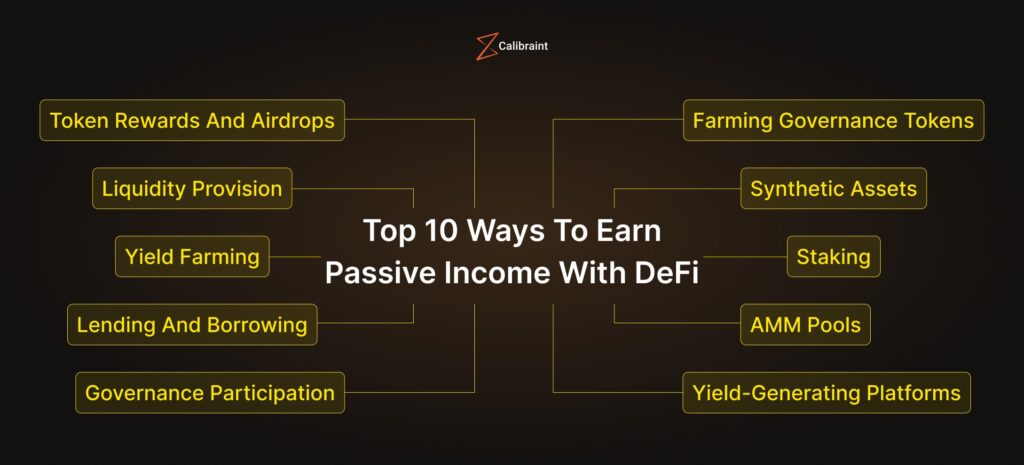
Top 10 Ways To Earn Passive Income With DeFi
Earning passive income with DeFi (Decentralized Finance) involves utilizing various decentralized financial instruments and protocols to generate returns on your cryptocurrency holdings. Here’s a simplified guide on how to potentially earn passive income through DeFi:
1. Liquidity Provision
Giving liquidity to decentralized exchanges (DEXs) like Uniswap or SushiSwap is one of the most popular strategies. Users can share in the trading fees by making contributions to trading pairs. This is one of the best ways to earn passive income with DeFi.
2. Staking
Native tokens are available in many DeFi income projects and can be staked to protect the network, take part in governance, and get incentives in the form of new tokens.
3. Yield Farming
Yield farming involves moving your funds between different DeFi protocols to take advantage of the highest yield opportunities. You can earn rewards, such as additional tokens or interest, by participating in liquidity provision, lending, or borrowing across various DeFi income platforms. It’s essential to be cautious and well-informed when yield farming, as it can be high-risk due to volatility and smart contract vulnerabilities.
4. Lending and Borrowing
Users of DeFi lending platforms can lend their assets to borrowers and receive interest as payment. Users can also borrow assets by pledging their own tokens as collateral. This is hence yet another best way to generate passive income with DeFi.
5. Automated Market Making (AMM) Pools
By contributing assets to assist efficient trading, users can earn fees by participating in AMM pools on websites like Balancer or Curve.
6. Synthetic Assets
Some protocols enable the creation or exchange of synthetic assets that mimic the value of physical assets and give users access to a variety of markets.
7. Farming Governance Tokens
You can acquire governance tokens by taking part in the governance of DeFi protocols. These tokens may increase in value if the protocol is successful.
8. Token Rewards and Airdrops
Some DeFi projects distribute tokens or conduct airdrops to holders of their native tokens. Simply holding these tokens in your wallet can lead to passive income when these events occur.
9. Governance Participation
Some DeFi platforms grant token holders the right to participate in the governance of the protocol. By voting on proposals and decisions, you may receive governance tokens or rewards.
10. Yield-Generating Platforms
There are DeFi platforms and services specifically designed to generate passive income. These platforms often employ complex strategies to optimize returns, and they may offer stablecoin yields, cryptocurrency-backed loans, and more
To get started with earning passive income with DeFi, you’ll need to research and select the appropriate DeFi protocols and platforms based on your risk tolerance, the assets you hold, and your investment goals.
It’s crucial to stay informed about the risks and conduct due diligence, as the DeFi space can be highly volatile and subject to smart contract vulnerabilities. Additionally, consider using secure wallets and following best practices to safeguard your assets.
Prepare to harness the complete potential of DeFi Development with our seasoned team of experts. Whether your requirements involve DeFi lending and borrowing platforms or asset tokenization, Calibraint possesses the expertise and know-how to transform your vision into reality.
Risk Management And Considerations
While earning passive income through DeFi can be rewarding, it’s also essential to consider the following risks:
1. Smart Contract Risks: Financial losses may result from smart contract bugs or vulnerabilities. Do your homework before participating in protocols.
2. Impermanent Loss: Your assets may lose value temporarily if you use liquidity provision rather than keeping them outside the pool.
3. Market Volatility: DeFi assets may be very erratic, which could affect the value of your holdings.
4. Regulatory Uncertainty: Given that DeFi is still in its evolutionary phase, potential regulatory shifts could influence its operational landscape and profitability.
Endnote
In short, to actively engage in earning passive income through DeFi, one typically requires significant experience and a substantial capital base to leverage high-volume opportunities and withstand potential losses. Importantly, this stands in contrast to the original vision of DeFi, which aimed to democratize financial participation, enabling anyone to partake in depositing, borrowing, and lending for wealth creation, thus challenging the traditional finance system’s exclusivity, long dominated by the wealthy elite.
For those willing to explore the decentralized financial terrain, making use of the potential of DeFi protocols presents intriguing opportunities for passive income generation. By mastering diverse strategies, conducting thorough research, and adeptly mitigating risks, individuals can creatively supplement their income through DeFi. It’s essential to bear in mind that the DeFi landscape is in a constant state of flux, so achieving success hinges on your ability to stay informed and adapt to its dynamic nature.
DISCLAIMER: This article is provided for informational purposes only and should not be considered as financial advice. It is essential to be aware that the value of digital assets is subject to fluctuations, and there is a potential risk of losing your entire capital. Prior to making any investment decisions, it is highly recommended that investors seek guidance from a qualified financial advisor.
Frequently Asked Questions
1. Is DeFi Staking Profitable?
Yes! DeFi staking can be profitable, but it depends on various factors, including the specific assets you’re staking, market conditions, and the platform’s rewards and risks. It’s important to research and assess each staking opportunity carefully.
2. How Can I Start Earning Passive Income Through DeFi?
To start earning passive income in decentralized finance, you can participate in liquidity provision, staking, yield farming, or lending on DeFi platforms.
3. What Are The Risks Associated With Earning Passive Income With DeFi?
Risks include smart contract vulnerabilities, market volatility, and potential losses. It’s crucial to research, diversify, and only invest what you can afford to lose.
4. How To Earn Passive Income With Crypto
To earn passive income with crypto, consider staking or lending your coins through reputable platforms, earning rewards for holding them. Alternatively, explore liquidity providing in decentralized finance (DeFi) protocols, generating income from transaction fees.
Calibraint
Author
October 1, 2023
Last updated: April 17, 2024
8
Let's Start A Conversation
Manage Consent
To provide the best experiences, we use technologies like cookies to store and/or access device information. Consenting to these technologies will allow us to process data such as browsing behavior or unique IDs on this site. Not consenting or withdrawing consent, may adversely affect certain features and functions.
Functional
Always active
The technical storage or access is strictly necessary for the legitimate purpose of enabling the use of a specific service explicitly requested by the subscriber or user, or for the sole purpose of carrying out the transmission of a communication over an electronic communications network.
Preferences
The technical storage or access is necessary for the legitimate purpose of storing preferences that are not requested by the subscriber or user.
Statistics
The technical storage or access that is used exclusively for statistical purposes.The technical storage or access that is used exclusively for anonymous statistical purposes. Without a subpoena, voluntary compliance on the part of your Internet Service Provider, or additional records from a third party, information stored or retrieved for this purpose alone cannot usually be used to identify you.
Marketing
The technical storage or access is required to create user profiles to send advertising, or to track the user on a website or across several websites for similar marketing purposes.