Top 10 Crypto Wallet Features Enterprises Must Implement in 2026
Calibraint
Author
February 3, 2026
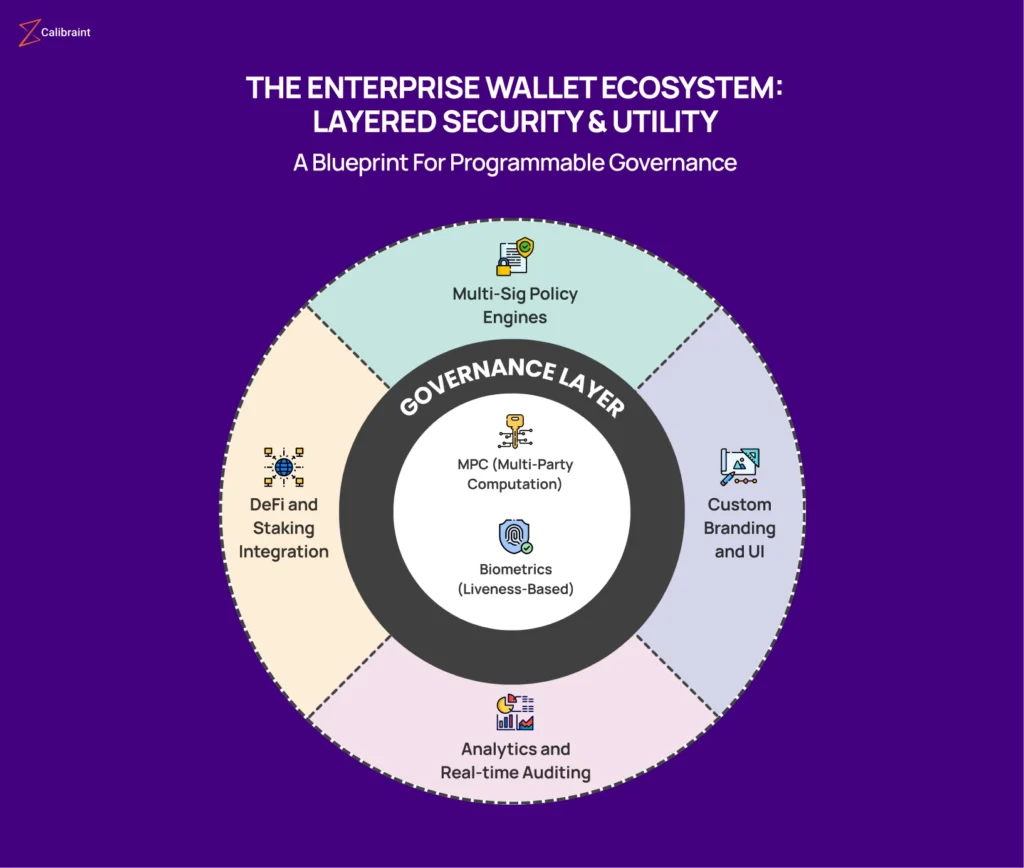
The time for simply experimenting with digital assets is over. Modern enterprises now prioritize sophisticated, programmable governance over mere possession. As global liquidity migrates toward on-chain environments, the infrastructure supporting these assets must evolve beyond basic storage. To succeed in 2026, you need a fusion of institutional-grade security and the fluid user experience high-net-worth clients expect. This evolution starts with a strategic approach to cryptocurrency wallet development, ensuring your firm maintains absolute control while scaling at the speed of the market.
Today, the focus isn’t on proving blockchain’s utility. The real challenge is building a secure, scalable gateway that bridges traditional financial rigor with the decentralized future.
This guide analyzes the Top 10 crypto wallet features your enterprise must integrate to remain competitive and compliant in a high-stakes economy.
1. MPC Key Management: Eliminating Single Points of Failure
Traditional private key storage creates vulnerability. One compromised key means total asset loss. Multi-Party Computation solves this by splitting cryptographic operations across separate entities without ever reconstructing the complete private key.
Here’s how it works in practice. Your treasury initiates a Bitcoin transaction. Instead of one person holding the complete signing authority, the system distributes encrypted key shares across three locations. Perhaps your New York office holds one share, your London office another, and your qualified custodian holds the third. The transaction requires cryptographic cooperation from two of these three parties, but none of them individually possesses enough information to move funds alone.
Regulated digital asset custodians and institutional wallet providers now operate MPC-based custody systems supporting thousands of assets across dozens of blockchain networks. These architectures reduce insider threat exposure, enforce segregation of duties, and support dynamic key refresh without requiring on-chain address changes.
Unlike on-chain multi-signature wallets, MPC executes signing operations off-chain, eliminating approval latency and enabling faster, automated treasury workflows. Typical implementations complete within four to six weeks, including documented key ceremonies and audit-ready controls, delivering materially lower operational risk with improved transaction efficiency.
2. Hybrid Custody Architecture: Balancing Control and Compliance
Enterprises rarely benefit from a single custody model. Some assets require direct control for operational flexibility, while others demand third-party custody to meet regulatory or fiduciary expectations. The most effective approach combines both within a unified architecture.
Institutional research consistently shows that enterprises segment digital asset holdings based on purpose. Core reserves often sit with qualified custodians that operate under regulatory oversight, maintain audited cold storage, and offer insurance coverage. Providers such as Fidelity Digital Assets, Coinbase Institutional, and Anchorage Digital meet these requirements through segregated storage, SOC 2 Type II reporting, and bankruptcy-remote structures.
Operational balances follow a different model. Organizations that interact with decentralized finance, staking, or on-chain settlement flows often rely on MPC-based self-custody platforms. This structure preserves control while distributing risk across multiple signing environments. The result is faster execution without sacrificing governance.
A common institutional allocation keeps 90 to 95 percent of assets in cold storage with delayed withdrawal processes, while reserving 5 to 10 percent for operational wallets. This tiered custody model protects capital while allowing responsiveness to market conditions. Enterprises adopting this structure view it as a risk management decision, not a technology choice, and it now forms a core design principle in enterprise cryptocurrency wallet development.
3. Multi-Chain Support Without Operational Fragmentation
Enterprise digital asset operations extend far beyond Bitcoin and Ethereum. Stablecoin settlements, tokenized assets, staking, and protocol participation span multiple blockchains. Wallet infrastructure must support this diversity without multiplying risk.
Enterprise wallets consolidate multi-chain support under a unified control plane. One approval workflow, one compliance layer, and one analytics dashboard govern activity across chains. This reduces operational overhead and minimizes the attack surface.
Fragmented custody across multiple single-chain wallets creates unnecessary complexity. Each additional chain introduces separate audits, integrations, reporting processes, and vendor dependencies. Unified multi-chain architecture solves this by standardizing private key management, transaction approval, and monitoring across ecosystems.
As institutional adoption accelerates, multi-chain readiness becomes a baseline requirement for serious Cryptocurrency wallet development rather than a differentiator.
4. Real-Time Transaction Monitoring for AML Compliance
Compliance obligations do not pause for operational convenience. Every transaction must undergo screening against sanctions lists and risk indicators before execution.
Enterprise wallet systems integrate real-time blockchain analytics that assess counterparty risk, transaction history, and behavioral patterns in milliseconds. These systems automatically block or flag high-risk activity while allowing legitimate transactions to proceed without delay.
Regulatory expectations around transaction monitoring continue to tighten, particularly across European markets. Coverage of evolving AML requirements and institutional monitoring standards appears in this institutional outlook from The Block.
Automated compliance workflows reduce reliance on manual review while producing audit-ready documentation. This capability protects both assets and reputation.
5. Hardware Security Module Integration for Key Protection
Software-only security cannot protect high-value digital assets at institutional scale. Hardware Security Modules isolate cryptographic operations inside tamper-resistant environments that meet government security standards.
HSMs generate, store, and use key material without exposing it to operating systems or networks. Physical tamper detection triggers immediate key destruction if unauthorized access occurs. This architecture blocks entire categories of attack.
When combined with MPC, HSM integration creates layered defense. Each MPC participant stores key shares inside dedicated hardware, distributed across secure locations. This design dramatically raises the cost and complexity of any attempted breach.
Enterprise audits increasingly expect HSM usage as part of responsible private key management in Cryptocurrency wallet development.
6. Native DeFi and Staking Integration: Yield With Governance Control
Digital assets need not remain idle. Institutional staking and DeFi participation allow enterprises to generate yield while maintaining custody and compliance controls. Ethereum staking, in particular, has matured into an institutionally acceptable yield mechanism supported by regulated infrastructure providers.
According to Ethereum Foundation documentation and institutional custody disclosures, staking rewards accrue directly to wallet addresses while assets remain under owner control. Custodians now support delegation without asset transfer, reducing counterparty risk. Accounting systems classify staking income transparently, simplifying tax treatment.
Liquid staking adds flexibility by issuing tokenized representations of staked assets. These instruments preserve liquidity while continuing to earn protocol rewards. Enterprises adopting this approach conduct rigorous due diligence, including smart contract audits and insurance coverage verification.
Prudent institutions begin with protocol-native staking before expanding into lending or liquidity provisioning. This phased approach allows teams to validate operational readiness and governance controls. In forward-looking cryptocurrency wallet development, yield generation becomes a strategic capability rather than speculative exposure.
7. Enterprise Analytics Dashboard: Decision-Making in Real Time
Visibility defines control. Enterprise teams require consolidated insight across holdings, transactions, risk exposure, and compliance status. Disconnected reporting tools undermine confidence and slow response. A unified analytics dashboard turns wallet infrastructure into a decision engine.
Effective dashboards present real-time valuation, transaction histories with audit trails, asset concentration analysis, and protocol exposure summaries. Alerts surface deviations before they become issues. Treasury teams gain immediate clarity without reconciling data across multiple platforms.
Integration elevates this capability. APIs connect wallet data to ERP systems, accounting platforms, and reporting tools used for board and regulatory review. [Bloomberg’s institutional cryptocurrency infrastructure integration with platforms like Elwood Technologies] highlights the importance of consistent valuation and reconciliation when managing crypto assets alongside traditional portfolios.
Dashboards also support operational efficiency. Automated reports replace manual compilation. Compliance documentation exports on demand. This efficiency directly improves governance while reducing operational overhead, a key outcome of thoughtful Cryptocurrency wallet development.
8. Custom Branding and UI for Institutional Trust
Generic interfaces undermine credibility. Enterprises managing internal teams or client-facing custody services require custom branding and UI consistency.
White-label wallet interfaces reinforce institutional identity and professionalism. They integrate seamlessly with existing systems and workflows, reducing training friction and improving adoption.
Custom branding also supports regulatory clarity by ensuring documentation, reporting, and access controls align with internal governance structures rather than external vendor defaults.
For enterprises offering custody as a service, custom branding and UI become a competitive requirement rather than an aesthetic preference.
Passwords no longer meet enterprise security standards. Institutions require authentication models that resist phishing, insider abuse, and credential theft. Advanced authentication combines hardware security keys, biometrics, and role-based permissions.
FIDO2 passkeys and hardware tokens provide phishing-resistant access. Biometric verification adds a layer tied to physical presence. Role-based controls ensure individuals access only what their responsibilities require. Approval thresholds mirror traditional treasury authorization structures.
Integration with enterprise identity providers such as Azure Active Directory or Okta centralizes access management. Security teams retain control while users benefit from streamlined authentication. This alignment reduces friction without weakening protection.
In modern cryptocurrency wallet development, authentication architecture receives the same scrutiny as key management. Both define who can act and under what conditions.
10. API-First Architecture: Connecting to Enterprise Systems
Wallet infrastructure does not operate in isolation. It connects to accounting, trading, risk, and reporting systems. API-first design ensures these integrations occur reliably and securely.
High-performing APIs deliver predictable uptime, fast response times, and granular permission control. Webhooks provide real-time transaction updates. SDKs accelerate development across engineering teams.
Security controls protect integration layers through encryption, IP restrictions, and scoped credentials. Sandbox environments allow thorough testing before production deployment. Institutions evaluating platforms prioritize documentation quality, recognizing that poor APIs increase long-term cost and risk.
Conclusion
By implementing the Top 10 crypto wallet features, enterprises can secure digital assets, maintain compliance, and scale operations confidently. Leading organizations treat wallet infrastructure as financial infrastructure. They demand auditable controls, integration readiness, and security models aligned with enterprise risk tolerance. They invest in cryptocurrency wallet development that supports growth without compromising governance.
Calibraint works with enterprises to design and build secure, compliant, and scalable crypto wallet infrastructure tailored to real operational requirements. From MPC key management and compliance automation to white-label interfaces and deep system integrations, Calibraint approaches wallet architecture as a business system, not a standalone product.
If your organization is evaluating digital asset custody, treasury operations, or client-facing wallet solutions, now is the moment to design them correctly. Explore how we architect enterprise-grade cryptocurrency wallet solutions that auditors approve, security teams trust, and leadership can scale with confidence.
FAQs
1. Which advanced security layers should enterprise crypto wallets implement in 2026 to prevent institutional-level cyber threats?
Enterprise wallets should combine MPC key management, hardware security modules (HSMs), multi-factor and biometric authentication, role-based access controls, and off-chain approval workflows. These layers ensure assets remain protected even if individual systems are compromised.
2. How do multi-chain and cross-chain capabilities improve scalability and user adoption in enterprise cryptocurrency wallets?
Supporting multiple blockchains under a unified wallet reduces operational complexity, lowers integration costs, and enables enterprises to access diverse DeFi, payment, and tokenization opportunities, improving adoption across stakeholders.
3. What role do embedded compliance features like KYC, AML, and transaction monitoring play in enterprise wallet development in 2026?
Integrated compliance tools automate sanctions checks, flag suspicious transactions, and provide real-time audit trails, ensuring regulatory adherence and reducing operational risk without slowing treasury workflows.
4. Why are DeFi, staking, and tokenization integrations becoming essential features in modern enterprise crypto wallets?
These integrations turn static holdings into income-generating assets, provide liquidity options, and allow participation in emerging tokenized markets, aligning wallets with institutional treasury and investment strategies.
5. How can white-label and customizable crypto wallet solutions help enterprises accelerate Web3 product launches in 2026?
Customizable wallets align branding, workflows, and reporting with existing systems, enabling faster go-to-market, smoother client adoption, and seamless integration into enterprise infrastructure without compromising security or compliance.
Calibraint
Author
February 3, 2026
Let's Start A Conversation
Manage Consent
To provide the best experiences, we use technologies like cookies to store and/or access device information. Consenting to these technologies will allow us to process data such as browsing behavior or unique IDs on this site. Not consenting or withdrawing consent, may adversely affect certain features and functions.
Functional
Always active
The technical storage or access is strictly necessary for the legitimate purpose of enabling the use of a specific service explicitly requested by the subscriber or user, or for the sole purpose of carrying out the transmission of a communication over an electronic communications network.
Preferences
The technical storage or access is necessary for the legitimate purpose of storing preferences that are not requested by the subscriber or user.
Statistics
The technical storage or access that is used exclusively for statistical purposes.The technical storage or access that is used exclusively for anonymous statistical purposes. Without a subpoena, voluntary compliance on the part of your Internet Service Provider, or additional records from a third party, information stored or retrieved for this purpose alone cannot usually be used to identify you.
Marketing
The technical storage or access is required to create user profiles to send advertising, or to track the user on a website or across several websites for similar marketing purposes.